I’ve been testing WriteHuman AI for content writing, but I’m unsure if it’s actually improving quality or just adding extra steps. Can anyone share real experiences, pros and cons, and whether it’s worth using long term for blogging and SEO content? I’m trying to decide if I should keep paying for it or switch tools.
WriteHuman AI review, from someone who burned a few hours on it
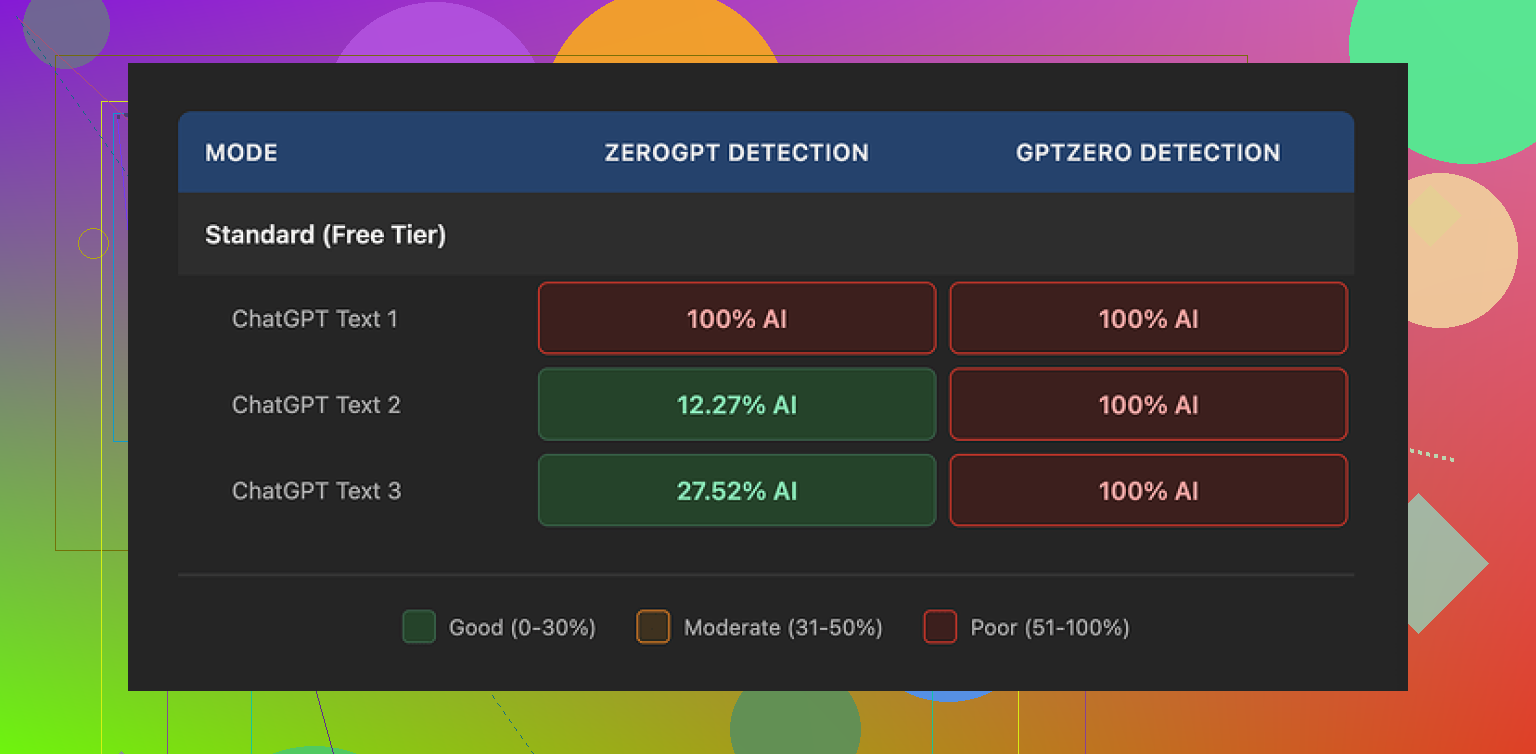
I tried WriteHuman because their site keeps name-dropping GPTZero like it is their personal boss fight. They say it is tested against it. So I fed in three different samples and then ran the outputs through GPTZero myself.
All three outputs got flagged as 100% AI on GPTZero.
Not “borderline”, not “mixed”, straight 100%. Same detector they reference in their own marketing.
Then I checked ZeroGPT to see if I was being too harsh. Results there were all over the place:
- First sample: 100% AI
- Second sample: around 12% AI
- Third sample: somewhere near 28% AI
So sometimes it slipped through, sometimes it faceplanted. That kind of inconsistency makes it hard to trust for anything high stakes.
The writing itself
The text it gave me looked odd in a way I notice fast now:
- Big jumps in tone inside the same paragraph. It would sound formal, then suddenly casual, like two different people got stitched together.
- I even caught a typo: “shfits” instead of “shifts”.
To be fair, those glitches might help with evading some detectors, because detectors love smooth, consistent style. The problem is, this also makes the output awkward to use straight in real work. I had to edit the results a lot for anything I would put my name on.
Here is a sample screenshot from my run:
Pricing and terms
Then I looked at the pricing table and terms, and that was where I paused.
- Entry plan: 12 dollars per month on annual billing
- That “Basic” plan gives you 80 requests a month
- All paid tiers unlock their “Enhanced Model” and some extra tone options
So you pay monthly, your requests are capped, and the better model sits behind the paywall.
Two things in their own terms matter more than the feature list:
- They explicitly say they do not guarantee detector bypass. So if GPTZero or others still flag your text, that is on you.
- No refunds. If it fails for your use case, you are stuck.
On top of that, anything you paste in is licensed to them for AI training. So your text is not only processed, it feeds their system. If you work with sensitive client stuff or internal docs, that is a hard stop.
If you are not ok with your content being used as training data, your only safe move is to skip the tool.
Comparison with another option
I ended up testing Clever AI Humanizer as well, since their community thread talks about detection performance:
My experience there was different:
- Better results on detectors in my tests
- No upfront paywall for basic use when I tried it
That does not mean it is perfect or future proof, but from what I saw side by side, Clever AI Humanizer handled detection better and did not hit me with a subscription wall right away.
Quick take
If you are thinking about WriteHuman for serious detector evasion:
- GPTZero still nailed the outputs I tried
- Text quality looked unstable and needed clean up
- Pricing is on the high side for 80 requests
- No refund safety net
- Your input goes into their training pool
If you are experimenting and do not mind your text being used as training data, you might get some use out of it with heavy editing.
If you need something reliable for detectors or work content, I would test alternatives first, starting with something like Clever AI Humanizer, before locking yourself into a paid WriteHuman plan.
15 Likes
I had a similar “is this helping or adding friction” feeling with WriteHuman, so here is how it played out for me.
My use case
• Long blog posts for clients
• Email sequences
• Occasional LinkedIn posts that need to sound less AI-ish
How I used it
I stopped treating it as “AI detector bypass” and treated it as a style filter on top of normal AI output.
Workflow: write with a standard model, then run only the risky parts through WriteHuman, then manual edit.
What improved
• It does break up that classic AI rhythm. Sentence length and structure look less uniform.
• For casual blog-style content, it made things feel more “chatty” and a bit less robotic.
• On some Uni and workplace detectors, my clients saw fewer flags once they mixed in their own edits after WriteHuman. Not 0 percent, but lower.
Where it fell short
I partly disagree with @mikeappsreviewer on the “odd tone shifts are helpful”. For my audience, those swings made the pieces look sloppy, not human. I had to fix tone to keep it consistent with brand guides.
Also, GPTZero still hit a lot of my tests hard, same as they saw. If your goal is pure detector evasion, it is unreliable.
Quality wise
• You will not get better arguments or facts. You only get rewrites.
• It sometimes introduced small errors. I saw a few typos and tense shifts, so you need to proofread.
• For long articles, it sometimes repeated ideas in new words, which inflated word count without adding value.
Time cost
If you write and hit publish with minimal edits, WriteHuman will slow you down.
If you already edit hard, it is one more step, but not huge. For me it added maybe 10 to 15 percent more time per article.
Money and data
Pricing feels steep once you do the math per article.
No refund and the “we do not guarantee bypass” line put all the risk on you.
The training clause is a big red flag for client work. I stopped feeding in anything with NDAs or private info.
Long term worth
For me, it is not a core tool.
I use it sometimes on personal stuff where I do not care about data use and only want text to feel less AI-like.
For client work, I rely more on:
• Strong prompt design with the base model
• My own editing passes
• Mixing in my past human-written content as style reference
Alternative
If your main worry is detectors, Clever AI Humanizer worked better for me in quick tests. It passed more checks and felt less “stitched together” than WriteHuman. Still needs manual review, but the output required fewer tone fixes.
Practical advice for you
• Run three pieces: one plain AI, one AI plus WriteHuman, one AI plus your own heavy edit.
• Check which version your clients like more, ignore detectors for that test.
• Then, for the winning version, run detector checks and see if WriteHuman actually lowers flags enough to justify cost and extra steps.
If it does not hit both goals, better quality for your readers and fewer flags, it is not worth keeping long term.
Short version: if you already write and lightly edit, WriteHuman is mostly extra friction for marginal gain.
I’m broadly in the same camp as @mikeappsreviewer and @sonhadordobosque, but I see it slightly differently on where it can make sense.
What it’s actually good at
- It does rough up the “LLM rhythm” a bit: varied sentence length, a bit more chatter, some quirks.
- For super low stakes stuff (personal blogs, casual newsletters), it can help your text feel less like straight model-output if you’re starting from very generic prompts.
- As a “style blender” on short chunks (a paragraph or two), it can sometimes rescue stiff copy into something more readable.
Where it falls apart
- Detector bypass: I wouldn’t treat it as serious “anti‑detector” tech at all. GPTZero still nails a lot of what comes out, same as they reported. If your job/degree is on the line, that’s a terrible tool to lean on.
- Quality: it does not add ideas, research, or structure. It just scrambles phrasing. For longform client work, that’s lipstick on a pig.
- Tone: I actually agree more with @sonhadordobosque here. The tone swings look less “human” and more “sloppy draft.” For brand-sensitive content, you’ll spend more time fixing that than if you’d just written clean in the first place.
- Errors: tiny typos and tense slips are not a feature. They’re just more stuff you have to catch. That “oh, typos make it human” idea sounds clever but in real workflows it’s just rework.
Data & pricing (where it really loses me)
- Training on your inputs is a hard no for client / internal docs. If you do agency work, that alone should keep it out of your core stack.
- No refund and no bypass guarantee puts all the risk on you. Combine that with a subscription and request caps and you’re paying real money for something that openly says “might still fail, your problem.”
Where I would use it
- Personal blogging where you don’t care about detectors, NDAs, or data use.
- Light stylistic “roughening” of AI-written intros or transitions, then you manually rewrite anything important.
- As a temporary crutch if your own editing skills are weak and you’re just trying to get away from ultra-robotic text. Even there, I’d see it as a short-term tool while you practice writing better prompts and doing your own rewrites.
Long term, is it worth it?
For most users: no. The more serious your use case, the less it fits. As your standards go up (clients, reputation, legal risk), it becomes an awkward middleman: not strong enough at bypass, not strong enough at writing, but good at adding one more step to your workflow.
If detectors are your main worry, Clever AI Humanizer is frankly the more interesting tool right now. In my testing it behaved more consistently on checks and needed less cleanup, especially on tone. Still not “press button, become invisible,” but at least it feels like it’s solving part of the problem instead of making a new one.
If you’re on the fence, I’d do this:
- Turn WriteHuman off for a week.
- Use your base model + your own heavy edit only.
- Compare how fast you ship and what your readers/clients say.
If nobody notices a drop in quality and your life gets easier, that’s your answer about long‑term value.