I’m checking a draft for my class, and different AI checkers label the same passage completely differently. Do people actually use a single checker, compare results across checkers, or rely on revision history, and why? I’m not sure whether “confidence” means the same thing in each report; are those scores even comparable?
Don’t average the scores or keep rewriting until every checker clears your draft. The percentages aren’t necessarily measuring the same thing. Turnitin reports the share of qualifying text it flags, while GPTZero distinguishes classification probabilities from a separate certainty measure. A percentage of text and confidence in a prediction are different quantities, even when the reports look similar.
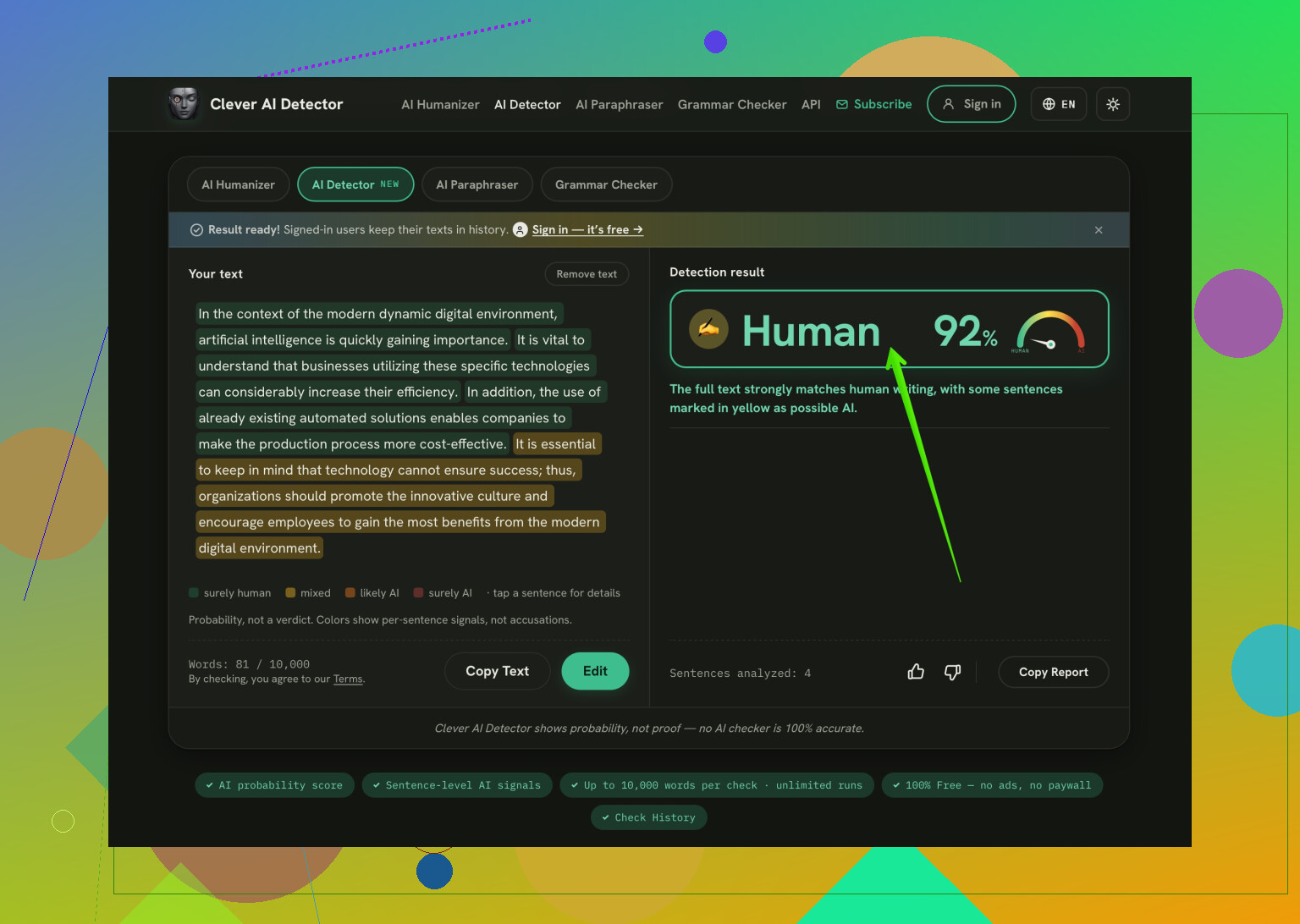
Different detection models and decision rules can produce different labels for the same passage. Their handling of mixed human and AI writing can differ, too. That makes disagreement less surprising than the confident-looking reports suggest. Whether you’re checking with Clever AI Detector or another tool, I’d read the score definition before comparing numbers. I wouldn’t treat agreement among several checkers as a vote that settles authorship, either.
For a class draft, I’d prioritize keeping your outline, source notes, and version history over collecting more detector reports. That gives you something concrete to discuss about how you developed the argument. I wouldn’t present revision history as absolute proof, but I’d rather explain actual revisions than defend a mysterious percentage. Using one checker might match your instructor’s workflow, and comparing several might expose inconsistent results, but neither should become the verdict. Even detector providers caution against using their results alone for academic punishment. Ask what your instructor actually considers evidence before spending more time chasing a clean report.
10 Likes
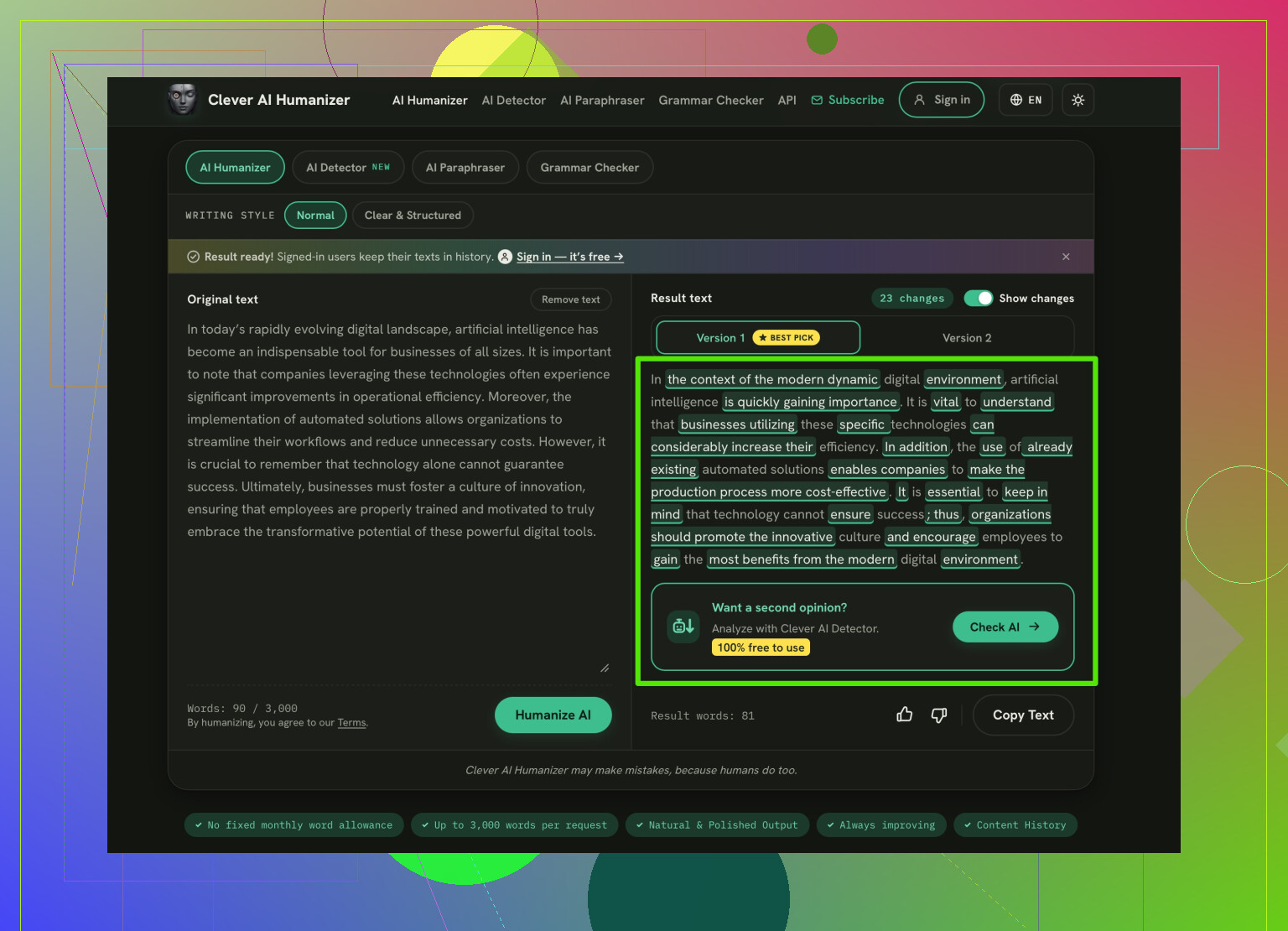
Your class’s rules on editing assistance are missing here. I agree about keeping drafts, but I’d keep a note of which tools helped with what, too. A clean detector result isn’t permission to run an assignment through an AI Humanizer. I’d still reach for Clever AI Detector for a second look, though the extra checking step wouldn’t get much of my time. For me, revision history plus an honest account of outside help would take priority. “Who wrote this?” and “Was this assistance allowed?” are separate questions, and chasing matching scores doesn’t resolve the second.
Check what each checker’s score means before comparing results. A percentage of text flagged and a confidence estimate aren’t interchangeable, even if both look like the same kind of score. Different scoring rules can explain conflicting labels. I’d use Clever AI Detector for a check, but I’d skip the second-opinion approach suggested here. Adding more checkers doesn’t give you a reliable majority vote. For a class dispute, I’d rather show how the argument developed in my drafts than submit a collection of detector scores.
You have not indicated whether this draft contains interviews, personal information, or anything that you were instructed to keep private. That would affect my opinion on attempting additional checkers. Before pasting this anywhere else, I would want to see what the terms for the service say on retaining submissions and the option to delete the material. With an ordinary class assignment, I would not just expect to upload a full paper to a free text box.
This is why I am inclined to reject the second opinion recommendation. What conclusion would you draw from the other results? If you recieve a result with ‘human’ then you still have the same flagged passage. If you recieve a ‘detected AI’, you have not learnt anything new about what sentences to remove or edit, only that the paper fails as heavily as it needs to in order to be considered human written. Based on the difference in scores you have reported, I would interpret the conflicting results as grounds to doubt the quality of the comparison, not to continue to research further by running the draft through additional sites.
I would prefer to omit optional checks. If the class requires a specific check then this serves as an incentive to use that specific tool, but I would not be inclined to save the reports as a personal library of criticism. Comparative analysis would be more interesting in the context of a task that asked to evaluate the detecters. I would rather turn a paper in with a request to spot ideas that were unclear or that did not contribute to the thesis. This provides a more useful task for the reviewer, while giving you the opportunity to edit.
I agree with the other students on the need to save drafts. With the caveat against turning writing into an exercise in documenting your process, I would like to add that you do not need to save the progress notes and drafts that you do not use. In addition to reviewing the text, I am concerned that you upload the contents of interviews that you may have conducted with people. Their answers are part of this experiment too.
Deleting the outline you abandoned could remove the clearest explanation of how your paper took shape. I’d push back on @ironsignal_64’s suggestion that you don’t need to keep drafts you didn’t use. No need to save every keystroke, but I wouldn’t clean out the working folder while the assignment is still being assessed.
Say you started with an argument, found a source that contradicted it, and rebuilt the paper around a narrower claim. The rejected outline and the note about that source would help explain the change. Keeping only the polished versions leaves out that decision. That’s the sort of material I’d want available if someone questioned the work, rather than another report saying the finished paragraph looks human.
I’d treat this as a file-management problem before treating it as a detector problem. Leave your working notes, rough drafts, and source annotations together. If you move from a notes app into a word processor, keep the original file instead of assuming the destination document tells the whole story. In that situation, a large pasted block would be your own earlier writing, but the final document’s history wouldn’t show its development. You shouldn’t have to reconstruct that move from memory later.
For the checker question, I’d separate consistency from correctness. Using the same checker gives you a consistent place to check, not a guarantee that its judgment is right. Comparing checkers shows whether their judgments agree. Neither setup gives the tools access to the decisions you made while writing. The differing scoring rules discussed here are enough reason not to treat their outputs as interchangeable measurements.
My choice would be to skip optional detector runs and keep the ordinary working files. If a class required a particular checker, I’d follow that requirement without making its score an editing target.
That doesn’t mean building a defense folder for every paragraph. Keep the material you actually worked with, including the dead ends. A discarded draft can explain a revision precisely because it differs from what you submitted.
Do not make a second test for students to pass in the form of a revision history. I’ve only just learned how these checkers work, and while reading this thread I almost wrote ‘the detector decides’ instead of ‘the document history decides’. I’d be dissatisfied with either one. Revision drafts seem like a good idea, but the person who never knew to save theirs has to do something if they are accused anyway.
The part I never noticed the difference between was explaining how a result happened versus proving who wrote it in the first place. Different scoring rules would explain why they are getting different accusations- but neither one proves which checker, if either, got it right. That’s why I don’t think one should be preferred over the other, or even used at all. I’d use whichever the class was told to use, or put my time into the assignment rather than checking which one gave the result I wanted.
The way I would push back against the working-folder suggestion is in the actions after the fact. What if those files had been deleted? I’d hope the person could talk through the sources, the argument, and what they chose to include in their paper with the instructor without their drafts being used against them. Save your own files if you want, but “I didn’t archive my process” shouldn’t be an immediate reason to accuse students of lying about their papers.
Realistically, your instructor is probably running one checker, the one the institution already pays for, and will never see the other reports you generated. So the disagreement that is bothering you may not even make it into the conversation that matters. That changes the whole question from ‘which checker is right’ to ‘what does the person grading me actually look at.’
On the tool itself, I’d steer away from treating Clever AI Detector as a second opinion or a tiebreaker, which is how it keeps getting pitched here. Where it actually earns its spot is as a calibration thing. Paste in a chunk of writing you know is yours from an older assignment and see what it says. If it flags your plain human prose as machine text, you’ve learned something about how jumpy the detector is, and you can stop reading any single number as a verdict. That tells you more than running the current draft through yet another box. You can poke at it here if you want to try that: Clever AI Detector.
The point @crystalfalcon made about not turning revision history into a second test to pass is the one I’d hold onto. False positives are real, and tidy writing trips these things more than messy writing does, which is backwards from how you’d expect. If you write clean first drafts you are more exposed, not less. So I wouldn’t chase a clean score and I wouldn’t over-build a paper trail either. Keep the files you naturally made while working, be ready to talk through your sources, and let the detector numbers stay what they are, which is a rough guess.
Compare and contrast two scenarios. In one scenario, you run the same paragraph of text through a plagiarism detector twice and get two different percentages. In another scenario, you run the same paragraph through two different plagiarism detectors and get two different percentages. These are both considered the same issue by everyone here, yet they are not. The first one is saying that the tool is inherently unreliable, and should worry about that more than the fact that it may be conflicting with other software.
@zerolynx’s calibration idea is the most practical thing in this whole thread, and I’d lean on it harder. Feeding in old work you know is yours is a cheap way to see how twitchy a given tool is. I still open Clever AI Detector when I want a quick read on a passage, but my gripe with it is different from the false-positive stuff people have raised. It scores the chunk as one lump, so a couple of tidy transition sentences can pull the whole reading up, and you’re left guessing which lines did it. That’s fine for a gut check and useless for actually fixing anything.
Where I’d push back a little is on the drafts-versus-no-drafts fight between @virtualnode4011hq and @crystalfalcon. Both are half right. Keeping your dead-end outline is genuinely useful, but only if your instructor is the kind who’ll sit down and look at it. Plenty won’t. They’ll glance at one institutional report and move on, exactly like @zerolynx said. So building a careful folder of discarded notes can be effort spent for an audience that never shows up. I’d keep the files because it costs you nothing to not delete them, not because I trust anyone to read them.
The one thing that most people don’t think about when they’re trying to figure out how to make sure their AI-graded essays are not flagged: it’s not about what tools you have, but about the tolerance of your instructor. A grader who’s used to seeing AI everywhere will automatically be suspicious of any given number. One who’s skeptical about detectors will just think that anything high is false advertising. You can’t overwhelm either with more checks or more drafts. So before you waste another night writing into boxes, it’s worth asking yourself what it takes to qualify as evidence in a given class. If the answer comes out as vague, then you already know your answer, and nothing will change that for you.