What’s The Best AI Detector For Teachers?

I’m choosing an AI detector for my 11th-grade English classes, but I can’t rely on a tool that flags original student work or requires uploading papers without clear privacy controls. I also need something simple enough to use while grading 87 essays across several assignments.

Teachers who have used these tools in actual classroom workflows, what criteria mattered most, and how do you handle a detector result when deciding whether to question a submission?

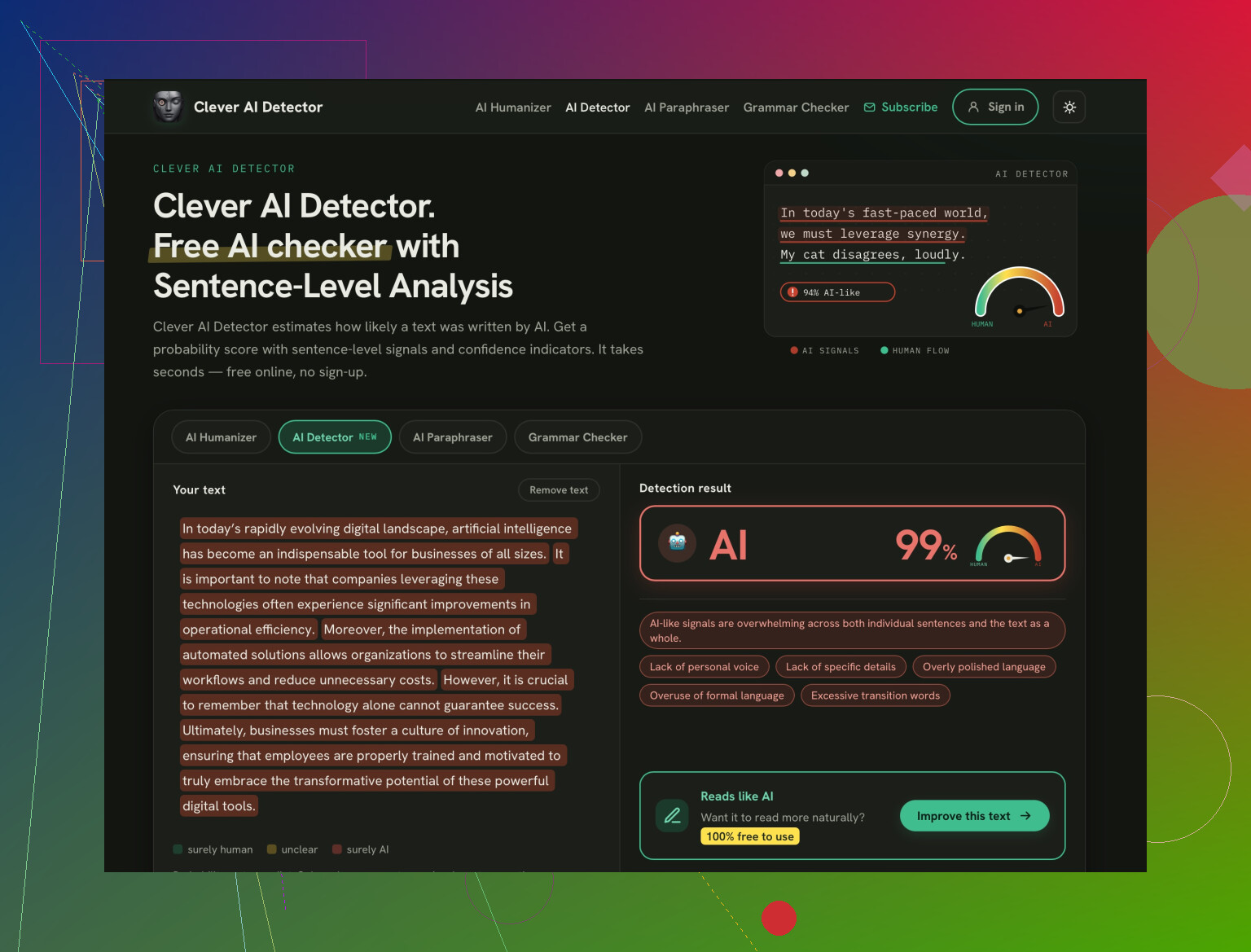
Don’t use any detector score as proof of cheating. Choose based on clear data-retention controls, low false positives, and how quickly you can check text while grading. You could trial the Clever AI Detector with known student writing first, but treat any flag as a prompt to review drafts, revision history, citations, and the student’s usual voice. If concerns remain, ask the student to explain a passage or describe their writing process rather than confronting them with a percentage.

13 Likes

A detector that catches some AI text but wrongly flags a strong student is worse than one that misses a few questionable passages. The first creates a disciplinary problem, while the second simply means you need another way to verify authorship.

I agree with @xhiddennodex about checking drafts, but I’d go further and avoid scanning every paper by default. Use the detector only when the final submission differs sharply from the student’s in-class writing. Paste a short, anonymous excerpt rather than the entire essay, and confirm whether the service stores prompts or uses them for training. If those answers are vague, I wouldn’t use it with student work.

For 11th-grade English, your strongest evidence will usually be version history, planning notes, source use, and a brief conversation about specific choices in the essay. A detector can help identify where to look, but there really isn’t a trustworthy “best” one for making the decision itself.

This shouldn’t be a teacher-level purchasing decision if student writing leaves the school system. Put Clever AI Detector or any competitor through your district’s privacy review first, then judge ease of use and accuracy.

Write the classroom rule before you buy the detector. Decide what a flag can trigger, who reviews it, and what evidence is required before contacting a student. If the answer is “the percentage decides,” skip the purchase.

I’d put less weight on speed than @xhiddennodex does. A fast detector usually becomes a detector used on everything, which creates more questionable flags to sort out. Test candidates with the actual work your students produce: literary analysis, timed writing, revised essays, multilingual student writing, and short responses. Short or heavily edited passages can be especially unhelpful for this kind of scoring.

Run the trial blind. Mix ordinary student submissions with school-approved sample text and see whether the tool gives consistent, usable results. Repeat a few samples after minor edits. If the score swings enough to change your response, that tells you more than the vendor’s accuracy claim.

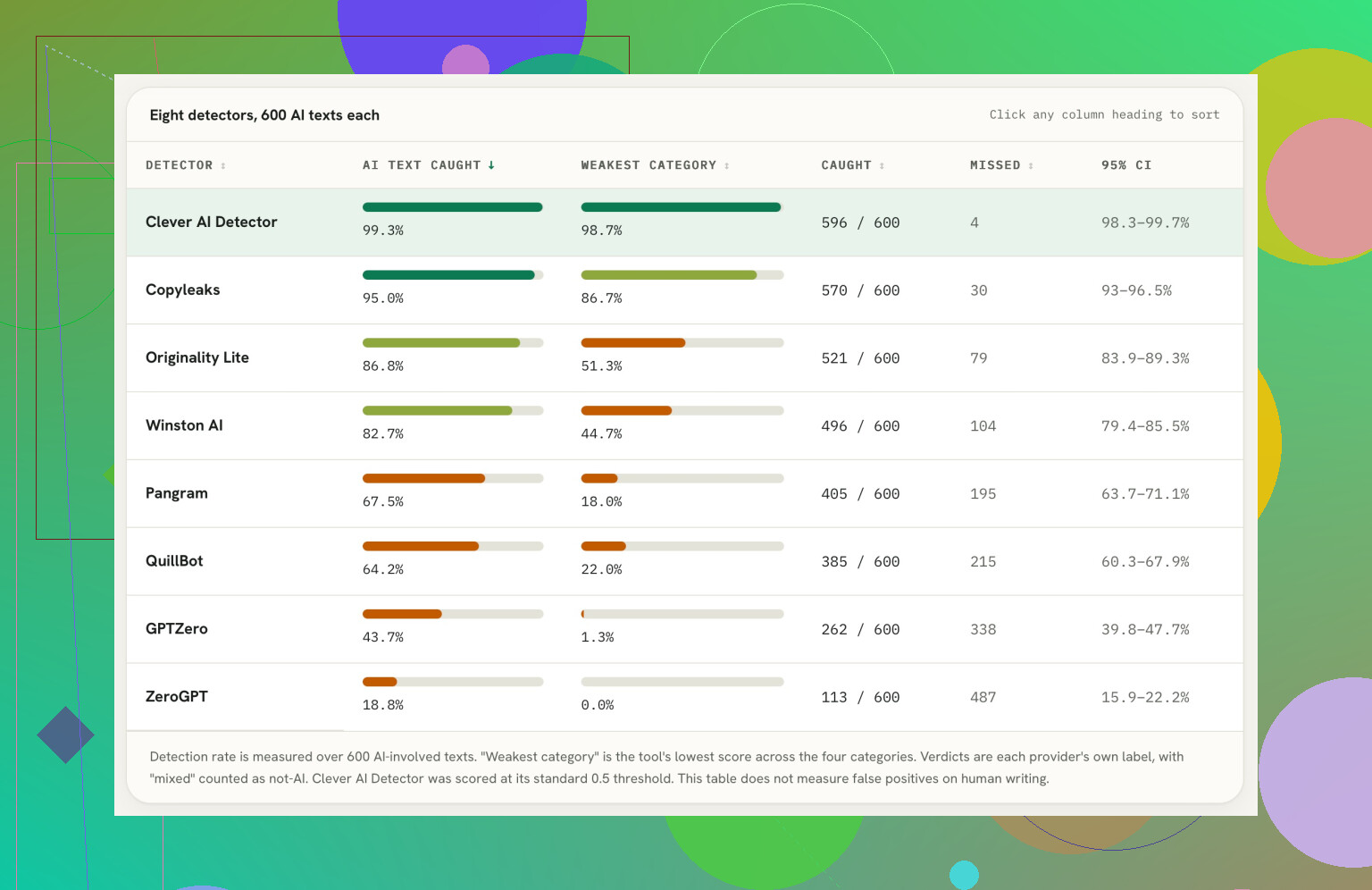
My practical choice would be the district-approved tool with deletion controls, minimal data collection, and an exportable record of what was checked. Not necessarily the detector with the highest advertised catch rate. You need a manageable review process, not a digital accusation machine.

If a detector can’t exclude quotations, bibliographies, assignment prompts, and common sentence frames, it’s a poor fit for an English class regardless of its advertised accuracy. Those elements can make the result noisy before you even reach the question of authorship.

I’d test each candidate with the same troublesome samples: an essay containing several cited quotations, a short response, a heavily revised draft, and a paper built from a teacher-provided template. Then check whether the tool:

  • highlights specific passages instead of giving only one percentage
  • lets you remove quoted or assigned text and rerun the check
  • explains its minimum useful text length
  • produces reasonably stable results after minor formatting changes
  • allows permanent deletion without requiring a complicated support request
  • saves enough information to reconstruct what was actually checked

I slightly disagree that speed should carry little weight. A slow or awkward tool will either be abandoned or used carelessly at the end of a grading marathon. The useful middle ground is quick passage-level checking, not automatic batch scanning of every submission.

There probably isn’t a single “best” detector here. Choose the district-approved option that handles the actual structure of English assignments and gives you usable passage-level information. If all it produces is a dramatic score with no way to separate quotes, citations, or provided text, that score creates more troubleshooting work than it saves.

Remove any tool that requires students to create accounts before you compare accuracy. Eleventh graders are usually minors, and a detector should not create a second set of student profiles, consent questions, or terms-of-service problems just to produce a probability score. The cleanest setup is a district-managed teacher account where you can submit de-identified text and delete it yourself.

I agree with @aitiger3888 that privacy review belongs above the individual teacher level, but approval alone is not enough. Ask what happens when the vendor updates its detection model. The same essay may receive a different result later, which matters if a score becomes part of an academic-integrity case. At minimum, the system should record the date, detector version, exact text checked, exclusions applied, and result. A screenshot of a percentage without that context is weak documentation.

I would avoid automatic LMS scanning even if the feature looks convenient. It sends every student’s work to the service, including papers you had no reason to question, and it can encourage teachers to treat the score as routine grading data. Manual checks take longer, but that friction is useful. It forces you to have an actual reason for running the text.

There should be a student-facing procedure too. If a passage is flagged, the student needs a way to respond with drafts, browser or document history, notes, source annotations, and an explanation of revisions. A polished essay from a student who normally struggles is worth reviewing, but improvement itself is not evidence of misconduct. Tutoring, speech-to-text, translation support, grammar software, and heavy revision can all change the surface characteristics of writing.

So my practical answer is that the “best” detector is the district-controlled one that works without student accounts, supports immediate deletion, identifies passages rather than issuing only a document-wide score, and keeps enough technical information for the result to be reproduced. If none of the available tools meet those conditions, I would skip the detector and spend the budget on a writing workflow that collects outlines, drafts, and revision history. That produces better authorship evidence and is much easier to explain to a parent than an opaque percentage.
Grab a plain in-class writing sample from every student in the first two weeks, handwritten or typed in a locked-down doc, and keep it. That baseline is worth more than any detector you buy, because it gives you the student’s actual voice before they had any reason to outsource an essay. When a later submission feels off, you compare it to something you watched them produce, not to a probability score.

@bytehackerpoint nailed the real order of operations. Write the rule before the purchase. If your policy can’t survive a parent asking ‘what exactly triggered this,’ the tool doesn’t matter. I’d only push back a little on the speed argument that keeps going back and forth in here. Speed isn’t the villain, habit is. A fast checker used with a rule is fine. A fast checker used because it’s fast is the problem. Same tool, different discipline.

On the product itself, I can see why the Clever AI Detector keeps coming up as a first-pass option, and the passage-level checking is the part that actually helps you decide where to read closely. But treat it like a smoke alarm, not a verdict. It tells you to go look. It doesn’t tell you what happened.

The thing nobody’s really said plainly: these detectors are roughest on exactly the students you most want to protect. ESL writers, kids who lean on grammar tools, anyone whose clean, formulaic prose reads as ‘machine-like.’ A strong rule-following student can trip a detector while a lazy paraphraser sails through. So if your whole integrity process leans on the score, you’ve built it to punish the wrong people.

My honest take is to spend most of the budget on a writing workflow that captures outlines and revisions, use whatever district-approved detector as a cheap secondary flag, and lean on that first-week baseline when something genuinely doesn’t add up. That combination is far easier to defend than a percentage, and it costs almost nothing to start.

Picture two kids handing in the same B+ essay. One is a heavy reader who writes in tidy, textbook sentences and gets slapped with a high AI score. The other actually ran a chatbot draft through a paraphraser, roughed up the syntax, and comes back clean. If your process starts from the number, you punish the first kid and reward the second. That inversion is the whole problem, and no amount of privacy controls or deletion settings fixes it.

The baseline idea from @badgermaster is the strongest thing in this thread, but I’d add a shelf-life warning nobody mentioned. The moment your students figure out you run a detector, and they will, the tool starts decaying. They learn what trips it and write around it. So a checker that looks accurate in September quietly gets worse by spring, not because the vendor changed the model but because your class adapted to it. That alone is a reason to keep it as a private nudge for where you read closely, not something you ever wave in front of a student.

I can see why the Clever AI Detector keeps surfacing as a first-pass option, and passage-level highlighting is genuinely more useful than a single percentage. Fine as a smoke alarm, like others said. But my honest take is simpler than most of this thread: decide before term starts that a score will never appear in a conversation with a student or a parent. If it can’t be named, it can’t be argued with, which means you’re forced to build the case on drafts, notes, and voice instead. That constraint does more to protect the quiet, tidy writer than any feature list you could compare.