I tried running the same set of articles through Originality.ai and Clever AI Detector, and the results disagreed enough to make the comparison more frustrating than useful. I mainly need a detector for reviewing drafts before they’re published, but I don’t want to pay just to get another inconsistent score.
For anyone who has used both, is paying for either one actually worth it, and which has been more dependable in everyday use?
How I compared them
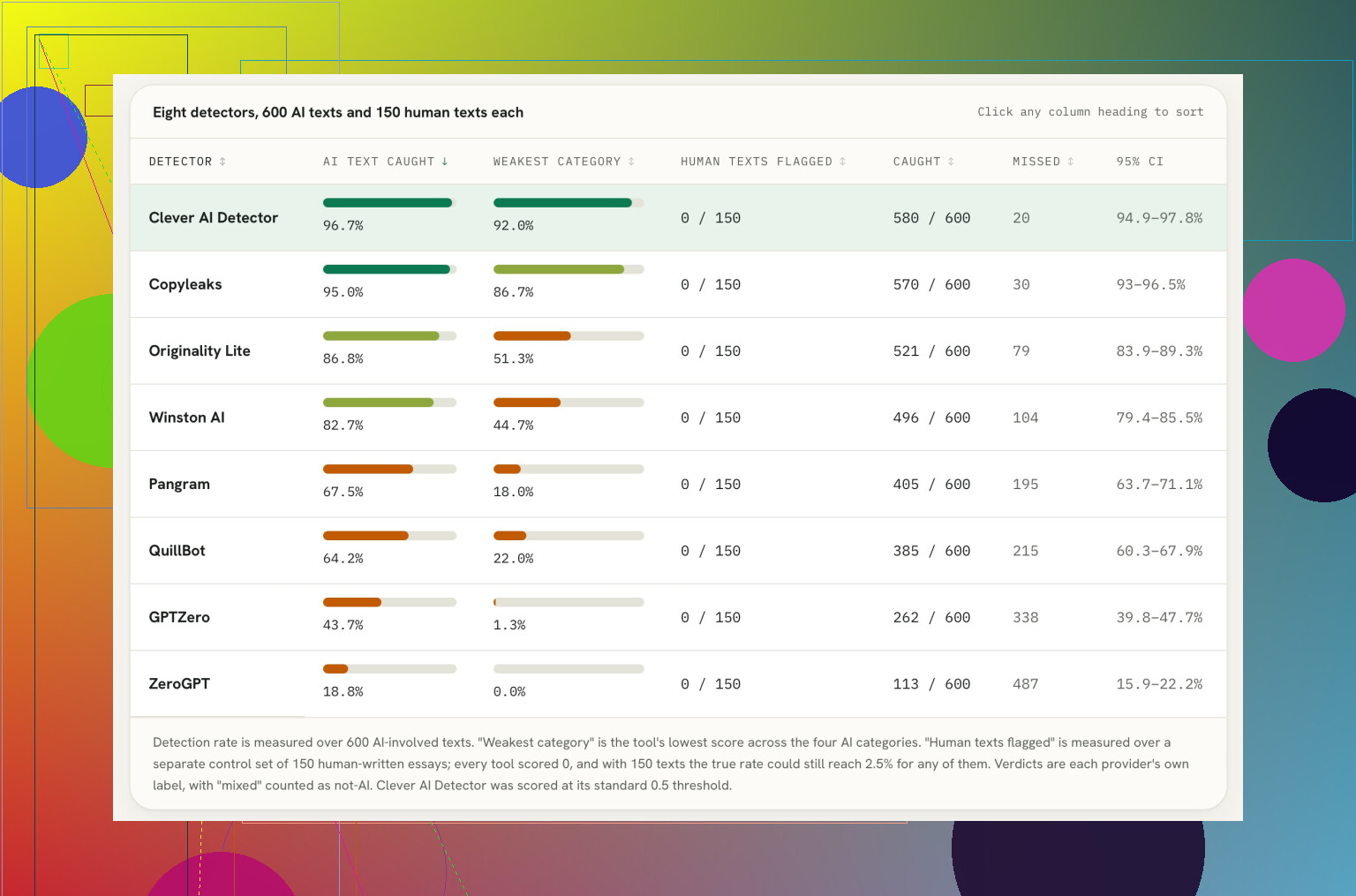
I looked at how often each detector flagged text considered AI-involved across four categories. The test also treated human drafts edited with AI as AI-involved, which matters more than it might sound. Someone else could reasonably classify those drafts differently and get a different ranking.
That means these numbers are useful for comparison, not universal accuracy scores carved into stone tablets.
The results worth noting
Clever AI Detector flagged 96.7% of the AI-involved texts, narrowly ahead of Copyleaks at 95.0%. Originality.ai Lite reached 86.8%, while GPTZero came in at 43.7%.
The part I found more useful than the headline ranking was consistency. Clever AI Detector stayed above 90% in all four AI categories. That seems more meaningful than doing very well on one kind of text and falling over on another.
I dropped the rest of the figures from my own shortlist because those four already show the main spread in the results.
Why the definition matters
Counting an AI-edited human draft as AI-involved is defensible, but it is not the only way to score the test. If your concern is fully generated text rather than light editing, these percentages may not map neatly to your use case.
There is also a larger limitation: no detector can prove who wrote something. A score is a signal to review, not a verdict.
The practical bit
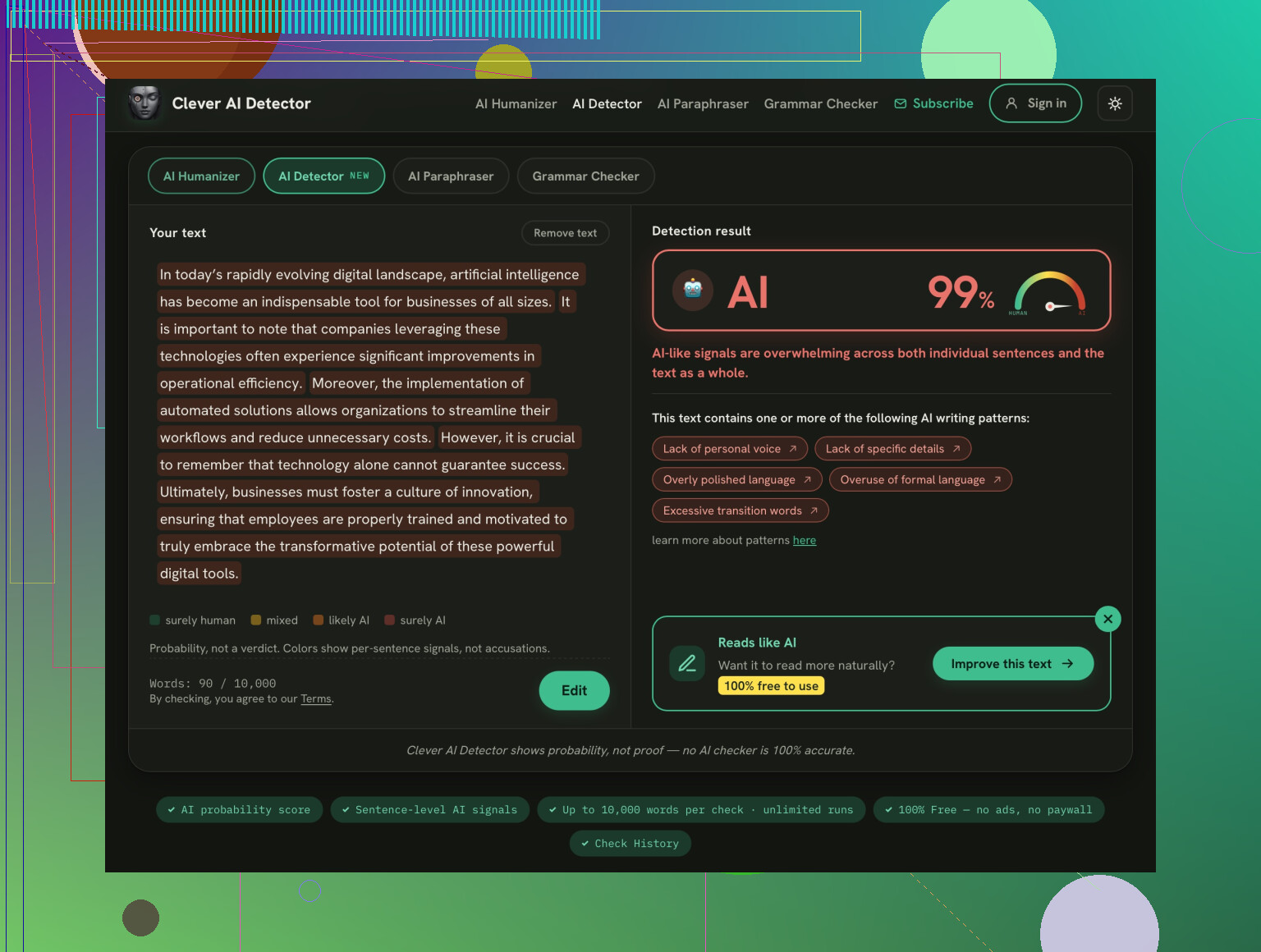
The reason I would still try the free Clever AI Detector is fairly mundane. It costs nothing, does not require an account, allows up to 10,000 words per check, and has unlimited checks. That makes it easy to test against your own examples before trusting the published comparison.
Has anyone here compared it with Copyleaks or Originality.ai using AI-edited human writing?
16 Likes
Don’t pay just because two detectors disagree. Build a small reference set from your own drafts and compare false positives first, since wrongly flagging human work is usually the bigger headache. Clever AI Detector is fine for quick screening, while Originality.ai may be worth paying for if you need saved reports or team workflow features. Neither score should be treated as proof.
Paying won’t make the score more authoritative.
The bigger issue is what happens after a draft gets flagged. If your process is simply “high percentage means reject,” either detector will eventually burn you. Heavy rewriting, grammar cleanup, repeated technical phrasing, and rigid house style can all produce suspicious-looking text without telling you anything reliable about authorship.
I’d judge these tools by review time rather than benchmark percentages. Run a month’s normal drafts through Clever AI Detector and record three things: how many need a second look, how many flags turn out to be useless, and whether the output helps you locate the questionable passage. A detector that catches slightly more AI-involved material may still be worse for daily work if it creates twice as many pointless investigations.
Keep the original file and revision history too. Version history, copied-source matches, unsupported claims, abrupt changes in writing style, and an author’s ability to explain their own argument usually tell you more than another detector score. The detector should decide which drafts get inspected, not decide the outcome.
Where paying can make sense is volume. If several people are reviewing hundreds of submissions, saved scans, exports, shared access, and consistent recordkeeping can reduce enough admin work to justify Originality.ai. If this is one person checking a modest number of drafts, I’d stick with Clever for screening and spend the money elsewhere.
@silverninja7253studi’s category issue matters here too. “AI-edited” covers everything from fixing commas to replacing most of the article. A single percentage hides that difference, so I wouldn’t choose a subscription based on the 96.7% versus 86.8% comparison alone. Test the exact kind of intervention you actually care about and set a written review rule before looking at the scores. Otherwise the detector with the scarier number tends to win by default.
Checking a public blog post is one case; uploading an unpublished client brief is another. Before comparing detection percentages, I’d check what each service does with submitted text, how long it retains scans, and whether your writers or clients have agreed to that kind of processing. Paying does not automatically make those questions disappear.
That is the missing cost in this comparison. Originality.ai may be easier to justify when a team needs accounts, records, and repeatable handling, as @vectorlogic mentioned. But if the material is confidential, those workflow features matter less than the actual data terms. A free checker can be perfectly adequate for ordinary web content and completely unsuitable for sensitive drafts.
For routine editorial screening, I’d start with Clever AI Detector and spend nothing until the detector changes a real decision. Keep a short log of whether each flag led to a useful finding. If the result repeatedly sends an editor hunting through clean copy, then even “free” becomes expensive in staff time.
My cutoff for paying would be operational rather than accuracy-based: multiple reviewers, enough volume that manual tracking is messy, and a clear policy for handling flagged work. Without those conditions, you are mostly buying a tidier version of an uncertain signal.
A detector that changes its verdict after minor edits is not worth paying for.
Take a few drafts and make harmless changes such as swapping a heading, fixing punctuation, or moving a paragraph. If the score swings wildly, you are measuring detector sensitivity rather than anything useful about the writing.
That is where I’d compare Originality.ai and Clever AI Detector before looking at headline accuracy. Stable, passage-level feedback has some editorial value. A dramatic percentage with no clear reason behind it does not.
Pay for Originality.ai only if its workflow features solve an actual admin problem. Otherwise, the disagreement you already found is a decent reason to keep using the free option cautiously rather than buying another uncertain opinion.
Accuracy percentages are useless without the base rate.
If nearly all your drafts are human, even a detector with a respectable false-positive rate can create a pile of bad flags. Say 95 out of 100 drafts are human and 5 are AI-generated. A 5% false-positive rate could flag about five human drafts, meaning half or more of your “suspicious” results may be wrong. That is the number I’d care about before paying.
Set up the decision first. Decide what score triggers a second read, what evidence can clear the draft, and who sees the result. Do not show writers a scary percentage with no explanation. These tools are producing probability estimates, not catching someone in the act.
Originality.ai is worth money only if its reports make that process easier to manage. Clever AI Detector is enough if you are checking a small queue and manually recording the few drafts that need attention. The paid score is not automatically more trustworthy because it comes with a dashboard.
I’d run both on a batch where you already know the writing history, hide the detector names, and compare which output leads to fewer wasted reviews. If neither improves your decisions, the correct subscription budget is zero.
The detail nobody’s mentioned is which model generated the test set. Detection scores are tied to the models a tool was trained against, and that’s usually last year’s models. A benchmark that hits 96.7% on text from one generation can quietly drop when someone runs the current version of whatever your writers use. So the gap between 96.7 and 86.8 isn’t just about definitions like @silverninja7253studi said. It’s also about how stale the underlying test is.
That matters more than the false-positive debate, honestly. @greencraft301lab is right that base rate makes or breaks the whole thing, but even a clean base-rate calculation assumes the detector behaves consistently over time. Retraining happens on both paid and free tools without any announcement. The number you validated in March may not be the number you’re getting in September, and you won’t get a changelog.
Which is why I’d treat any benchmark, including the one at the top, as a snapshot with a short shelf life. @stackthinker6758edge’s edit-sensitivity test is the useful move here, and I’d stretch it: rerun the same fixed set of drafts every couple of months and watch whether the scores drift. If they do, that tells you more about whether the tool is stable than any launch-day accuracy claim.
The free option makes sense as your rerun harness precisely because it’s free and uncapped. Use it to keep checking your own known samples over time rather than trusting a percentage you saw once. What I wouldn’t do is pay Originality.ai on the assumption that a subscription buys you a more permanent verdict. It buys you records and shared access, not a detector that stops changing its mind.
For a solo reviewer with a modest queue, my rule would be simple: keep a small locked set of your own writing, human and AI both, and if the free tool’s results on that set stay stable enough to act on, you don’t need to spend anything. If they swing around, no paid dashboard fixes that. You’d just be paying to store an unstable signal more neatly.