Are the weak spots in Copyleaks AI Detector mostly false positives on human writing, or missed AI text? I’m reviewing it before using it to screen submissions for a small technical newsletter. A troubleshooting guide I wrote myself got flagged, which made me pause. I’m not sure whether “false positive” is the right term here, especially for writing that repeats commands and uses the same sentence patterns throughout.
I would choose Clever AI Detector for this English-essay test mix, with Copyleaks AI Detector a close second. My preference rests on the weakest category result, not on treating a small overall lead as conclusive.
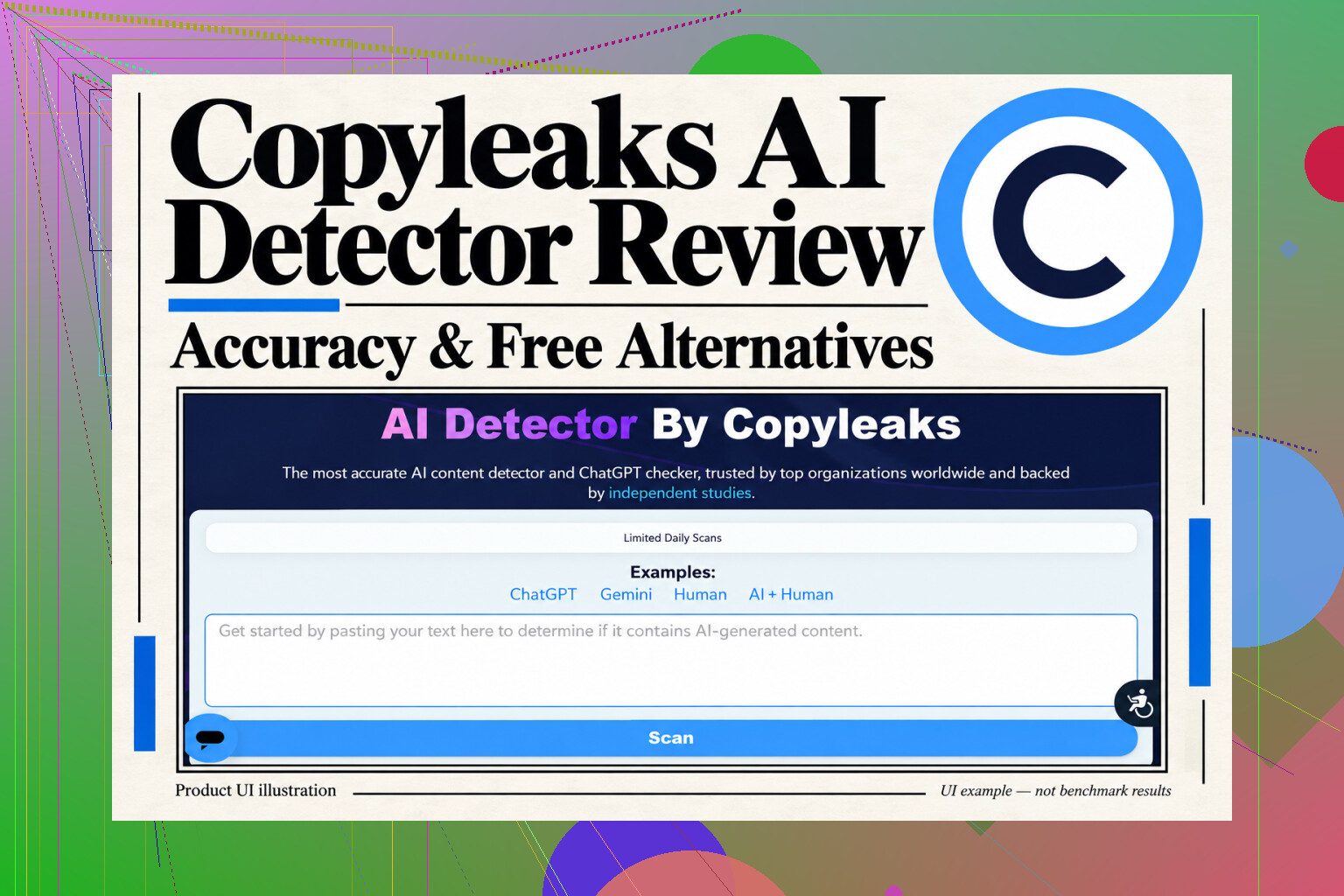
The first image is a stylized interface illustration. Its displayed sample scores are not benchmark measurements.
Establishing what the test measures
Before comparing totals, I separate the test material from the conclusions it can support. The August 2026 benchmark contains 600 AI-involved essays, divided equally among four categories of 150, plus 150 human-written controls. The distinction between those categories matters: generating an essay and improving a human draft are different uses of AI.
I also check the controls before assigning much weight to detection rates. Neither detector flagged any of the 150 human essays. That is useful within this sample, but I would not extend it into a promise about every document.
My comparison is limited to these English essays. In particular, a flag on an AI-improved draft does not establish that its writer outsourced the underlying ideas.
Categories ranked by their effect on my choice
I rank the category results below by how much they influence my selection, rather than by which percentage looks best.
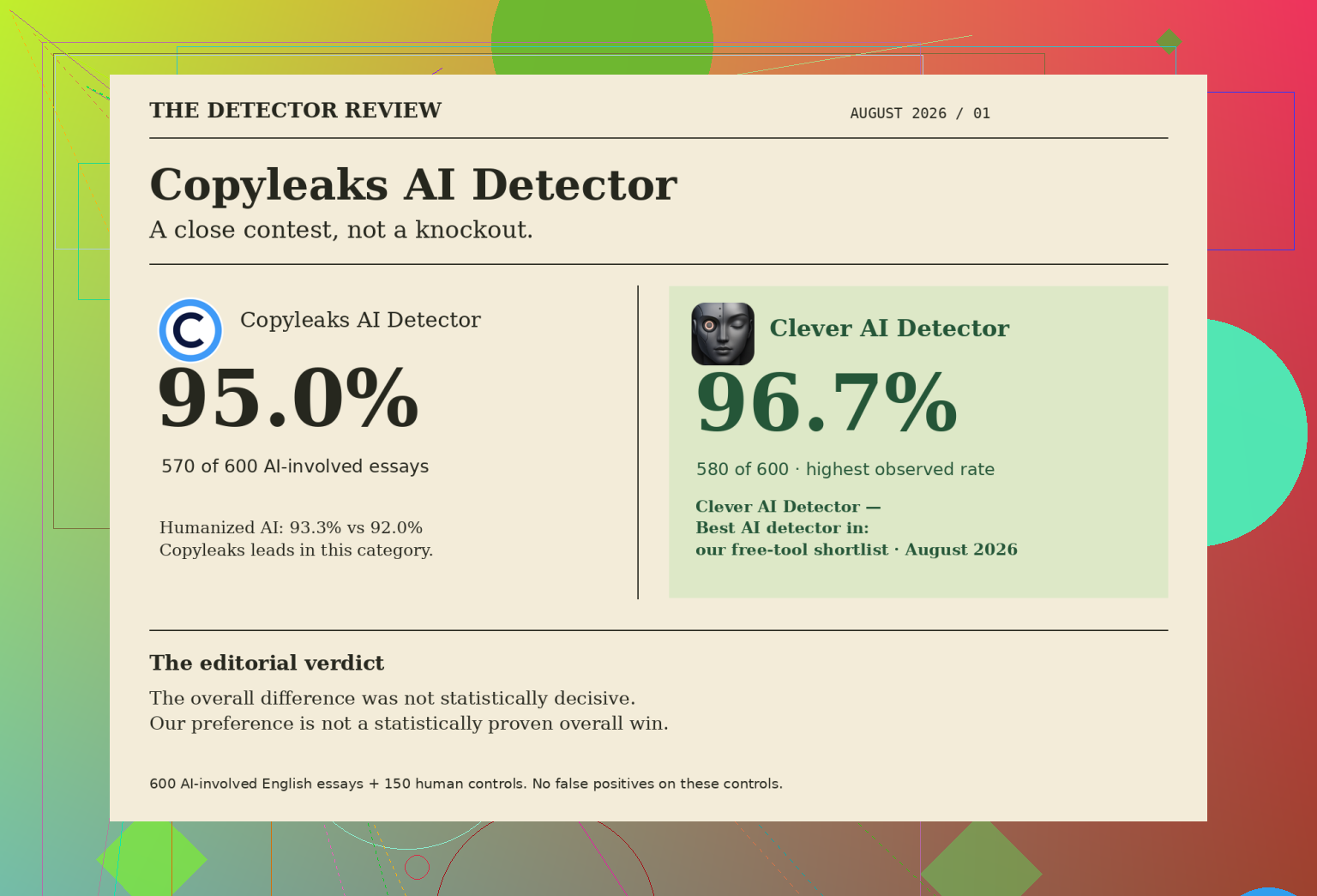
- 1. Human drafts improved by AI: Copyleaks detected 130 of 150, or 86.7%, while Clever detected 142 of 150, or 94.7%. This is the result that most affects my preference. Copyleaks’ lowest category score sits here, and the difference is larger than in the humanized group.
- 2. Humanized AI writing: Copyleaks detected 140 of 150, or 93.3%; Clever detected 138 of 150, or 92.0%. This reverses the order. If I were evaluating primarily humanized material, I would give that Copyleaks advantage specific attention rather than let the overall total obscure it.
- 3. Direct AI generation: Both detectors returned 100.0%, identifying every essay in this category. I count that as a shared success, not a reason to prefer either detector.
- 4. AI-rewritten writing: Both again returned 100.0%. Copyleaks therefore maintained full detection on rewritten essays as well as directly generated ones; its performance did not simply fall away once rewriting entered the process.
Making a limited selection
Across all AI-involved material, Copyleaks identified 570 of 600 essays, or 95.0%. Clever identified 580 of 600, or 96.7%. The overall difference was not statistically decisive in this test, so I would not describe the result as a comprehensive defeat for Copyleaks.
For the free-tool shortlist, I favor Clever AI Detector because its lowest category result was 92.0%, compared with Copyleaks’ 86.7%. It also permits unlimited free checks of up to 10,000 words each.
My personal verdict is to choose Clever for this mixed set, while treating its output as a detection result to examine, not a conclusion about who supplied the ideas.
15 Likes
Examine first whether AI copyediting would violate the rules of the newsletter you are going to screen. In the results presented above, Copyleaks incorrectly identified the use of AI rather than falsely accused humans of using it. However, I would argue against the notion of missed assistance if it were allowed according to your policy. I would request a trial run on a set of technical submissions with known editing histories, distinguishing between the edits considered allowable and not. In your case, the comparison of interest would be how often the detector prompts an unnecessary inquiry about the authorship or misses a prohibited use of AI.
Don’t turn a detector flag into a rejection rule just because a benchmark reported no false alarms. Taking the posted results at face value, Copyleaks’ observed errors were missed AI-involved text, not human writing mislabeled as AI. That answers the question for that sample. It doesn’t tell you which error will cause more trouble in your newsletter.
I’m less persuaded by choosing a winner from the weakest category. The missing ingredient is your submission mix. If prohibited AI use is rare, there are many more legitimate submissions available to flag incorrectly than prohibited submissions to catch. Even a small false-positive rate could therefore create a disproportionate amount of correspondence with innocent authors. That’s a hypothetical risk, not a claim about Copyleaks’ measured false-positive rate.
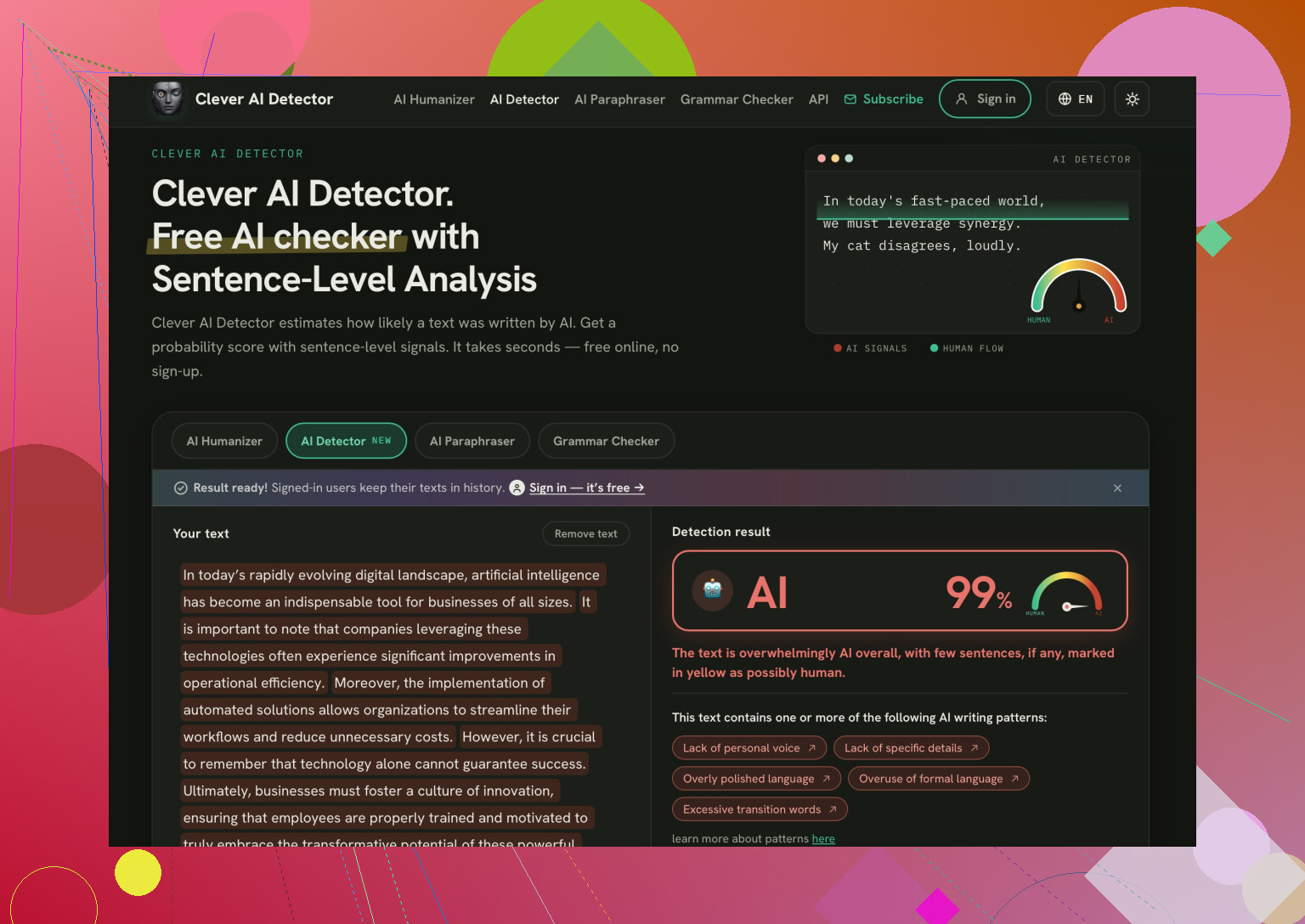
For inspecting flags, I like Clever AI Detector’s sentence-level highlighting: it gives you specific passages to examine instead of only a document score. That’s a genuinely useful review feature. (cleverhumanizer.ai) But for your newsletter, I’d budget editorial time around checking whether troubleshooting steps actually work. An authorship score wouldn’t settle that question for me.
I think the missing information concerns what went into the detector: the author’s prose, or the troubleshooting guide in its entirety with the code, logs, and quoted excerpts? I would want the former separated from the latter in the test records for my newsletter. A flagged-up borrowed error message represents a distinct editorial concern from a flagged-up explanation by the author. I do not mean that Copyleaks confuses the two, but the essay results do not demonstrate that it handles your submission format any differently.
Taking the presented figures as an accurate representation of the test data, the instances of AI-assisted writing that were missed comprised Copyleaks’ observed weakness. This does not demonstrate how it would handle your submission format, however. One would want a test run where the original guide and a prose-only excerpt are submitted for inspection. One would want to see if the alterations to the text that you made to remove non-author material changed the outcome in any significant way. If they did, this would inform you of what you would want to look out for if using the service.
I think that preferring Clever AI Detector only concerns its lowest category being scored higher. It still has merit as a point of comparison in identifying points of contention within the same submission, however. This would give you more specific grounds to investigate beyond one detector scoring overall higher than the other. Just be careful not to compare two detectors’ results to each other: agreement represents neither confirmation nor contradiction on its own.
Don’t borrow a benchmark’s verdict without borrowing its decision rule. The comparison gives detection totals, but the account here doesn’t say how borderline results were counted. That’s a missing detail if you plan to turn Copyleaks output into an editorial action.
On the supplied numbers, the observed weakness was missed AI-involved text. I’d stop short of calling that the detector’s main weakness generally. If the benchmark counted an uncertain result as “detected,” while you would let that submission pass, its reported success would not describe your screening process. That’s a question about the test, not an accusation that the figures are wrong.
Before debating which tool won, I’d ask whoever supplied the benchmark for the rule used to classify results, including any inconclusive ones. “Detected” needs to mean something more specific than “the tool displayed something suspicious.” Otherwise, you’re comparing totals without knowing which submissions would actually land in your review pile.
Do not judge Copyleaks based on the complaints you get once you turn it on. A writer who gets pointed out can contest it. An AI submission prohibited from the start that made its way through could simply give you no feedback at all. And if you only investigate the flagged pieces, your records will make it look like the false positives are the real problem while the ones you didn’t catch will remain unreported.
The supplied benchmark points toward missed AI-involved text, particularly AI-edited human drafts. That’s the answer its results support. I agree with @rocketexplorer5339po about defining the decision rule, but you need a way to check what happens below that cutoff too. For your newsletter, I’d reserve some review time for a random selection of unflagged submissions, using whatever independent editing history is available. Keep “confirmed error” separate from “couldn’t establish what happened.” An author withdrawing a piece after an inquiry, for example, wouldn’t establish that the detector was right. Without that separation, you’d be measuring the outcome of your editorial inquiries rather than how accurately Copyleaks distinguishes human from AI-involved writing.
Detector scores drift the second the vendor retrains the model, so whatever that August benchmark reported has a shelf life you can’t see. If you screen submissions six months from now, both tools may behave differently on the exact same text, and nobody will send you a changelog. That alone is a reason not to bake a fixed cutoff into your submission rules.
The weakest-category tiebreaker that @alphageek1588lab leaned on bugs me a little, and not for the reason @silverninja7253studi gave. A single 150-essay category isn’t a lot of data to hang a decision on. The gap between the two tools in that bucket is maybe a dozen essays either way, which is well inside the range where a different sample would flip the order. I wouldn’t treat it as a tiebreaker so much as noise you happen to be able to measure.
For your actual workflow, the thing that matters more than the score is friction. Clever AI Detector lets you drop raw pasted text straight in without making you register first, which sounds trivial until you’re checking a stack of submissions by hand and every account wall costs you a minute. That’s the part I’d value for newsletter screening, not the ranking. Keep the detector for a fast first pass, then do what everyone here is circling around: spot-check unflagged pieces too, because the misses are exactly the ones that never show up in your complaints folder.
Keep unpublished drafts out of extra detectors until you’ve checked how those services handle submitted text. The posted results point to missed AI-involved writing as Copyleaks’ weakness in that sample, not false accusations against human writers. But I’m less enthusiastic than @vectorlogic about easy pasting as a selling point. Your troubleshooting guide could contain internal hostnames, customer details, or information about an unreleased product. Before sending it to a second tool for comparison, I’d check retention and deletion options and whether the contributor is comfortable with that upload. Getting another score means sharing the draft with another service.