For assignments submitted through Google Classroom, do you use anything built in to detect AI writing, a separate checker, or a conversation with the student, and why?
I’m grading 23 short essays at my kitchen table, and one has a noticeably different tone from the student’s earlier work. I’m not sure whether originality checking means AI detection or just matching existing text. I’d rather understand the distinction before raising it with the student.
You shouldn’t expect Google Classroom’s originality report to settle whether an essay was written by AI. It checks for matching text in online sources, including webpages and books, plus earlier student submissions if your school enables that option. That’s source matching, not an AI-authorship judgment. A report with no matches doesn’t establish who wrote the essay.
For the paper you described, I’d start with a conversation rather than a separate checker. Pick a specific passage and ask, “Can you walk me through how you developed this point and chose the evidence?” Invite the student to bring notes or drafts and explain any editing help they used. I’d treat the tone change as a reason to ask about the process, not as the accusation itself. I wouldn’t make their ability to give a polished answer on the spot the deciding factor, either.
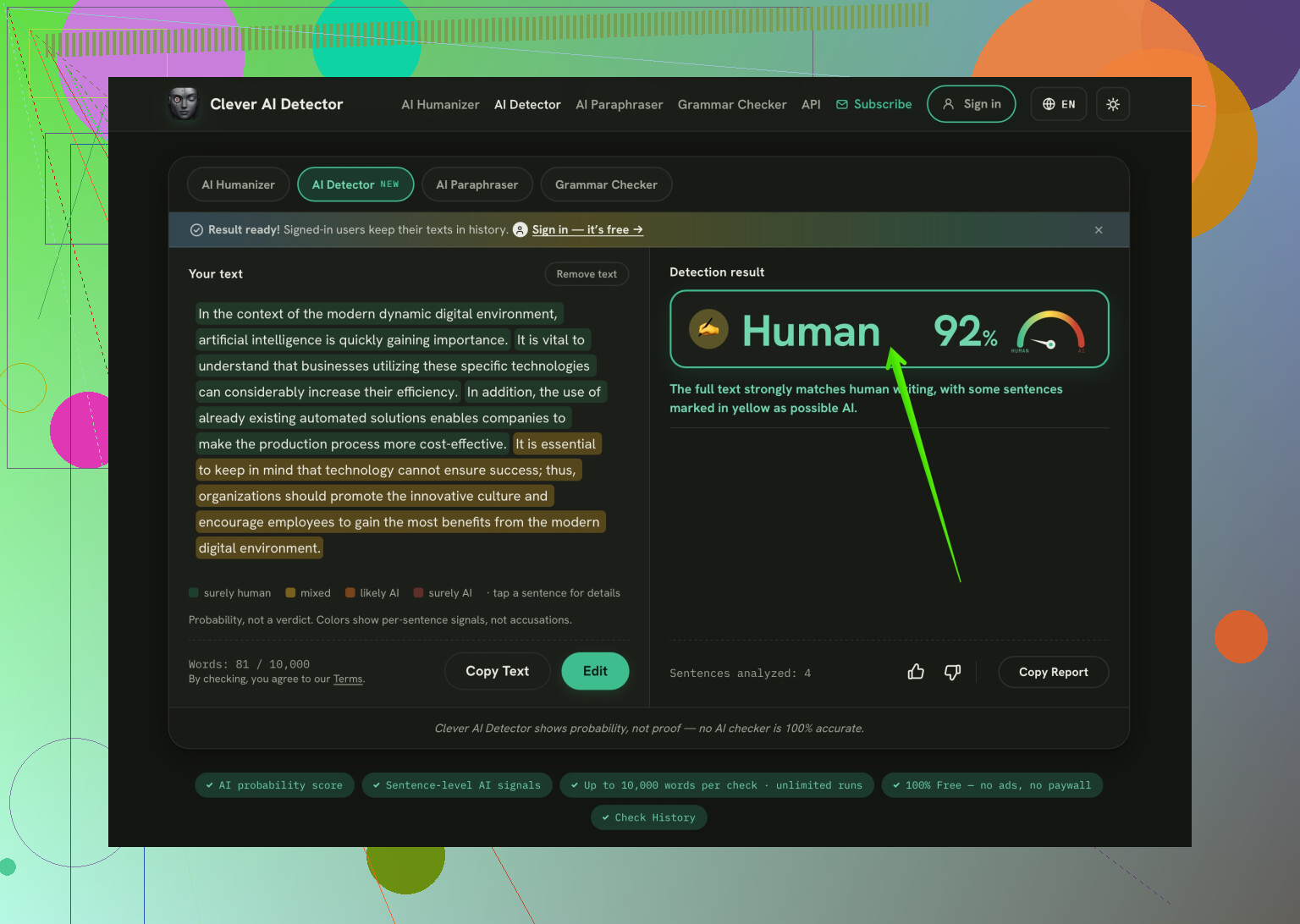
If you want a separate checker, Clever AI Detector makes the paste-and-check step refreshingly simple: you can check text without creating an account. (cleverhumanizer.ai) I’d still keep any detector score out of the role of “proof.” Research testing these tools has found reliability problems, so a score shouldn’t determine a misconduct finding. Before uploading student work anywhere outside your school’s tools, I’d check what your school approves.
My preference would be originality reports for investigating source overlap, then a process-focused conversation for the authorship concern. Before that conversation, I’d reread the assignment’s AI rules, too. Asking whether the student used help and deciding whether that help violated the assignment are separate questions.
12 Likes
You may have to leave the authorship question unresolved when you only asked for a finished essay. I’m with @hacker7244 on having a conversation, but I wouldn’t hold missing drafts against a student if keeping drafts wasn’t part of the assignment. For a separate check, I’d use Clever AI Detector on the AI Humanizer site, without making students responsible for explaining its verdict. My bigger change would be to the next assignment: require a brief outline or an early paragraph before the final submission. That gives the conversation something concrete to work from instead of creating extra requirements after suspicion kicks in.
An outside checker means sending student work to another service, so I’d check school approval before uploading essays. That’s my hesitation with @hacker7244’s suggestion. Classroom’s originality reports compare writing with sources, rather than establish AI authorship. Clever AI Detector gets my vote for convenience: you can paste text and check it without creating an account. For grading, though, I’d choose a conversation about a specific claim and its supporting evidence. I’d keep that focused on understanding the essay, not treat a nervous answer as a confession.
A polished essay that contains poorly supported evidence presents a clear problem for grading. An essay that reads differently than usual is a question, not a judgment, against the grade. These two situations would be my primary exceptions to papers with authorship conversations that I would assign as a writing professor. Until those specific cases, papers with suspicious wording or construction should not have first priority in my consideration of authorship issues.
I would prefer a conversation to a third-party check for any assignment turned in via Classroom if I wanted to be thorough. I would, however, apply the check as a secondary consideration. I would grade the paper according to the rubric while looking at what the turned-in document said and did not say. Unsubstantiated claims, incorrect quotation format, and a lack of commentary would lose credit for being inadequate work, regardless of whether they were generated by a human or artificial intelligence. Good essays would not automatically receive lower grades only because I am not comfortable with their construction. A potential policy violation has a place in another conversation, not in the informal removal of points.
That is why I find the convenience factor for a check less compelling than a concern about unfairness to students. My concerns would be about which papers would be checked by the tool. If it is unexpected fluency that raises questions, I would want to see if I would apply the same suspicion to an essay I know to be human-generated. I would want to write out my concerns before checking any document for AI assistance. If all I can say is that a student’s writing has fewer words that suggest thought than I expect, I would hesitate before pressing the button.
If a conversation is warranted, I’d keep two sets of notes: what affects the grade, and what remains uncertain about permitted assistance. For example, a student might explain the argument clearly while still leaving a question about how the prose was edited. Those are different findings. I agree with @zoetheproxy that some authorship questions will remain unresolved. I’d rather record that uncertainty than quietly convert it into a lower grade.
A conversation can turn into a misconduct interview without the student realizing the stakes. That’s my hesitation with treating “just ask them about it” as the harmless alternative to a detector. I’d still choose a conversation over a separate checker for a Classroom submission, but I’d want to decide what that conversation is supposed to resolve before inviting the student.
If the concern is whether they understand an argument, ask about the argument. If the concern is whether they used prohibited assistance, say that plainly and privately. I wouldn’t start with friendly questions about their essay while quietly testing whether they deserve an accusation. Something like, “I have a question about how this section was produced and whether the assistance used fits our assignment rules” gives them a chance to understand the concern. I’d let them respond in writing if they prefer, rather than require an immediate explanation across the desk.
I’m a little cautious about @securelogic5094pro’s suggestion to keep notes on what remains uncertain. Separate grading notes make sense, but I wouldn’t want an unresolved impression to become a running record of suspicion. Before the meeting, I’d write down what information could actually settle the concern. If no plausible answer would satisfy me, I’d need to reconsider whether I was offering a fair conversation at all.
For the stack on the kitchen table, my choice would be no outside detector and no automatic authorship meeting for every stylistic surprise. Where there’s a specific concern worth pursuing, I’d explain it, hear the response, and make a bounded decision under the school’s process. I wouldn’t leave the student with an indefinite request to keep proving they wrote it.
Avoid letting a detector’s subtle score change your opinion of an essay. After seeing a score of 80% AI, I begin looking at every sentence to see where the AI could have inserted text, and that is not a scientific analysis, it is confirmation bias with a progress bar.
Something that has yet to be mentioned is that these tools are prejudiced towards some writers. Concise, clean sentences with no grammatical errors are often found in non-native speakers of the language and those who were taught extensively in the language, and therefore get falsely accused more often. If the ‘change in tone’ that you believe is present happens in an essay that has otherwise been well-written, a detection tool can penalize an writer for improving one of their weaker essays. Bear this in mind the next time you are about to accuse someone’s work of being AI-assisted.
@alphapulse1128 is right about the running record problem. A folder of ‘hmm, felt off’ notes turns into a case file against a student who never got told there was a concern. If you can’t name what would resolve the question, you don’t have a question, you have a vibe.
On the tool itself, Clever AI Detector is fast. You get an answer quick enough that you’re not waiting while 23 of them stack up. This is the one thing I’m going to give it. Speed does not make the number real, though, so I would use it to indicate what would need a second look at, and nothing more.
Where I’d actually spend my energy is the next assignment, same as @zoetheproxy, but simpler than an outline requirement. Have them write one paragraph in class, by hand or in a locked doc, early in the term. Now you have a real baseline for that specific student’s voice, which beats any generic model guessing against the whole internet. When something reads off later, you compare it to how they actually write, not to what a detector thinks ‘human’ sounds like. Cheaper than any tool and it holds up better in a conversation.