I recently tried using an AI humanizer tool I found through Ahrefs recommendations to make my AI-written content sound more natural, but the results were mixed and I’m worried it might hurt my SEO or look fake to readers. Can anyone share real experiences, settings, or best practices for using Ahrefs-recommended AI humanizers safely for content and rankings?
Ahrefs AI Humanizer review from someone who wanted it to work and kinda regretted the time spent
Ahrefs has a solid name in SEO, so when I saw they added an AI “humanizer” I went in with moderate expectations. Not hype, more like, “ok, they have the resources, this should at least be usable.”
Here is what I ran into.
Ahrefs AI Humanizer interface and first red flag

The interface is simple. You paste your text, hit the button, wait a few seconds, and it spits out a “humanized” version.
Then you see something odd.
Right above the output, Ahrefs shows an AI detection score. On their own humanized text.
Every single test I ran hit 100% AI. Not only on external detectors, but inside Ahrefs’ own interface.
So you end up in this weird situation. The tool says “here is your humanized text,” then one line above, it quietly tells you “this is AI.”
I checked multiple samples, different lengths, different topics, even some messy drafts from things I wrote myself. Same result: flagged as AI every time.
External AI detection tests
I ran their outputs through:
GPTZero
ZeroGPT
Both gave 100% AI probability on every Ahrefs humanized sample I tested.
No edge cases. No “partially human” or “mixed” scores. Straight 100.
Here is the Ahrefs screen for context:
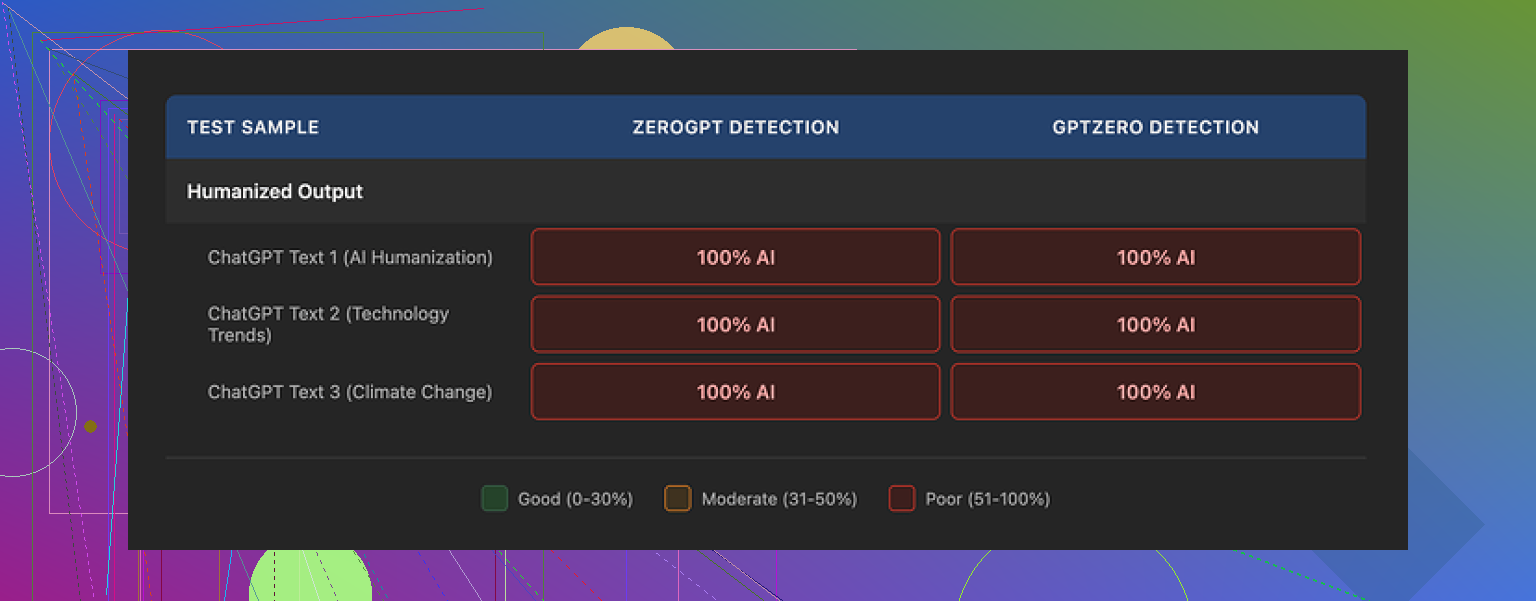
So if your main goal is to reduce AI detection scores, this tool did not help me at all.
Writing quality
Putting detection aside, the writing itself is not terrible.
I would put it around 7/10:
- Grammar: clean.
- Flow: fine for blog content or basic web copy.
- Tone: generic and safe.
Some problems jump out fast:
- Em dashes stayed untouched. Detectors often key on those patterns in AI text, so leaving them in is not ideal.
- It keeps classic AI-style intro phrases. Stuff like “one of the most pressing global issues” still shows up at the start of paragraphs.
- Sentence structure felt very similar across outputs, like minor paraphrases instead of different voices.
You could probably use this for cleaning up a rough draft, but calling it a “humanizer” feels like a stretch based on how it performed against detectors.
Control and customization
This part felt thin.
What you can adjust:
- Number of variants, from 1 to 5.
That is it.
No controls for tone, formality, reading level, region, or content type. No way to tell it “write like a Reddit post” or “make this sound like a corporate email.”
The only possible workaround is:
- Generate 3 to 5 variants.
- Copy the output into a doc.
- Manually pick and stitch together sentences that sound less repetitive.
I tried that for one long text. Took time and did not move AI detection much. Output still got flagged as AI at 100% on both external tools.
So the whole “one-click and done” idea does not happen here. You end up editing anyway.
Pricing and terms
The humanizer sits inside Ahrefs’ Word Count platform.
Plan details when I checked:
-
Free tier
- Lets you use the humanizer.
- No commercial use allowed on the free plan.
-
Pro tier
- About $9.90 per month if paid annually.
- Humanizer included with:
- Paraphraser
- Grammar checker
- AI detector
Important parts in the policy:
- Submitted text might be used to train AI models.
- No clear statement on how long your humanized outputs are stored.
If you handle client work, or sensitive drafts, that storage bit and training usage are worth thinking about.
How it compares to Clever AI Humanizer
I tested the same pieces of text with Clever AI Humanizer and had better luck.
Link for context:
On my samples:
- Clever AI Humanizer outputs scored lower on GPTZero and ZeroGPT.
- I got at least some content falling into “more human-like” territory instead of 100% AI every time.
It is not perfect, and detectors are inconsistent across the board, but it outperformed Ahrefs humanizer in my runs.
Also, Clever AI Humanizer is available at no cost at the moment, so it is easier to experiment with without locking into a subscription.
My take after using Ahrefs AI Humanizer
If your main goal is:
- Reduce AI detection scores,
- Get something that passes common detectors out of the box,
then Ahrefs AI Humanizer did not deliver that for me.
If your goal is:
- Light rewriting,
- Minor cleanup,
- Getting a neater version of text you already have,
it might be useful, but there are other tools doing that with more control over tone and style.
If you try it, I would:
- Run your original text through GPTZero and ZeroGPT.
- Run the Ahrefs humanized output through the same tools.
- Compare scores and see if the change is worth your time.
If detection scores matter for your use case, I would test Clever AI Humanizer in parallel, since it gave me better results without extra cost.
12 Likes
You are right to worry about SEO and how fake it feels. Tools like Ahrefs’ humanizer do not fix the core issue.
A few direct points:
-
AI humanizer and SEO
Google says they care about helpful content, not whether it is AI or human. The risk is not “AI detected”, the risk is shallow, generic text and zero originality. If the humanizer keeps the same structure, ideas, and bland tone, it does nothing for you on that front. -
Detectors are noisy
What you and @mikeappsreviewer saw lines up with most tests I have seen. Detection scores jump around. They fail on real human text and fail on edited AI text. Basing your strategy on “getting under X percent AI” wastes time and does not protect you from an update. -
Biggest SEO risk
The real risk is:
- Thin, interchangeable content.
- No personal experience.
- No examples or data.
- Same advice as the top 10 pages.
Humanizer tools tend to smooth writing and remove quirks. That often pushes content closer to “bland commodity” territory.
- What to do instead of pushing more humanizer passes
Use the AI for draft and structure. Then spend your time adding what the tool cannot know:
- Your own tests, numbers, screenshots, workflows.
- Short opinions and strong takes.
- Small stories of “I tried X, here is what broke”.
You can even leave a few “imperfections” in. Slightly varied sentence length, some shorter lines, a few contractions, a natural aside. Those feel human and help readers stay.
- Practical workflow that keeps you safe
Try this on your next article:
- Let AI write a rough draft.
- Delete weak sections and rewrite the intro and conclusion yourself.
- Add at least 3 to 5 specific examples or mini case studies from your work.
- Add 2 or 3 internal links to related content that you know helps users.
- Read it out loud once. If a sentence makes you roll your eyes, rewrite it.
If you still want a tool step, use a normal editor or paraphraser as “grammar + clarity”, not as “humanizer”.
- Where I slightly disagree with @mikeappsreviewer
They focus heavily on detector scores. Helpful for testing, but I would not use GPTZero or ZeroGPT as a success metric. Your main metric should be:
- Time on page.
- Scroll depth.
- Clicks to other useful pages.
- Conversions or signups.
If those go up, who cares what an AI detector says.
So if Ahrefs’ humanizer makes your content sound more generic, skip it. Use AI to help you write faster, then spend your effort on adding proof, opinions, and details only you know. That is what helps with SEO and makes readers trust you.
You are not crazy to feel weird about it. I played with the Ahrefs humanizer too and had the same “uhhh this still feels like AI” reaction.
Couple of things I’d look at instead of obsessing over the tool itself:
-
Your use case
If your goal is “make AI text sound less robotic so readers trust it,” the Ahrefs humanizer is kind of mid. Like @mikeappsreviewer said, it mostly just paraphrases. It smooths stuff, but it does not add voice, opinions, or lived experience. That is exactly what readers (and honestly, Google) care about. -
Detection vs reality
I slightly disagree with how much weight people give those detectors, including some of what @mikeappsreviewer focused on. They are useful to sanity check, but not something to build a strategy around. I have seen 100 percent “AI” on text that was written by a human who just happens to write clean, boring prose. Chasing lower scores can accidentally push you into more generic content. -
Where the humanizer can actually be useful
Ahrefs’ thing is ok if you treat it as:
- Quick rewrite for small sections
- Cleaning up awkward phrasing
- Giving you a second version to edit by hand
It is not ok as:
- “Press button, now it is safe for SEO”
- “Press button, now it looks human”
You still need to:
- Rewrite intros and conclusions in your own voice
- Inject real examples, data, screenshots, mini stories
- Add small opinions like “this part actually sucks in real life because…”
- How to keep it from looking fake
Instead of another AI pass, try these quick fixes on top of whatever the tool gives you:
- Add 2 or 3 “this is what happened when I tried X” type lines
- Mention a mistake, not just polished advice
- Use more specific nouns: tools, settings, timeframes, prices
- Cut any sentence that sounds like a school essay (“in today’s digital landscape” etc.)
If you read a paragraph and you cannot tell it is you speaking, it is probably still too AI-ish.
- About SEO risk
Here is the uncomfortable part: the risk is not “Google caught me using AI.” The risk is “my article feels like every other article, so nobody stays, clicks, or links.” On that front, I think @cazadordeestrellas is absolutely right: humanizers tend to sand off the exact quirks that make your content memorable.
So yeah, using Ahrefs’ humanizer by itself will not save you, but it also will not instantly nuke your SEO. The danger is relying on it instead of doing the annoying but necessary part: adding stuff only you could have written.
Short version: Ahrefs AI Humanizer is fine as a basic rewriter, weak as a “make this feel human and safe for SEO” button.
Where I slightly push back on others in this thread: I think it can still have a place in a workflow, but only if you treat it as a blunt text transformer, not as a strategy.
Pros of Ahrefs AI Humanizer
- Simple UI, fast output
- Decent grammar and readability for generic blog content
- Works as a quick “clean up this messy paragraph” helper
- Lives inside the same environment as their other tools, which is handy if you already use them
Cons of Ahrefs AI Humanizer
- Their own detector still calls the output AI, which kills the “humanizer” branding
- Tone feels safe and generic, which is exactly what hurts you in competitive SERPs
- No granular control over style, audience, or format
- Possible data use for training and unclear storage window
- Encourages the wrong mental model: “fix AI with more AI” instead of “fix AI with actual experience”
Where I agree with @cazadordeestrellas and @viajantedoceu: the real SEO threat is sameness. Humanizers flatten voice. That is the opposite of what you need if you are chasing rankings on topics already saturated.
Where I partially disagree with @mikeappsreviewer: I would not spend much time benchmarking AI detection scores across tools. I would rather run a small live test:
- Publish one article mostly cleaned by Ahrefs AI Humanizer.
- Publish another where you skip the humanizer and instead:
- Tighten structure with any editor
- Add strong personal takes, data, and concrete outcomes
Then compare actual metrics: clicks, engagement, conversions. If the “more human work, less humanizer” piece wins, that tells you more than any detector.
If you want something that explicitly aims to bypass detectors, tools like Clever AI Humanizer exist, but I would only touch them for edge use cases like academic environments or strict client requirements. For public web content and SEO, your long term asset is recognisable voice, not undetectability.
So, my practical angle for “Ahrefs AI Humanizer Review” content:
- Position it as a light rewrite / proofreading helper.
- Be very clear it does not meaningfully reduce AI detection in most tests.
- Emphasize that using it is neutral for SEO at best and harmful if it makes you ship more generic posts instead of fewer, richer ones.
If you keep it in your stack, use it on micro-level stuff like:
- Smoothing a clunky paragraph
- Rephrasing a sentence you are stuck on
Then do the heavy lifting yourself: structure, argument, stories, and the bits that actually differentiate you from the other ten pages on the SERP.